The Running Order as a Map of Hand-offs
A running order for concert hand-offs clarifies who acts, what information moves, and who owns each transition so backstage changes stay coordinated.
A concert running order works better when every transition has an owner, not just a time and a title. A running order for concert hand-offs shows who must act next, what information they need, and who confirms that the change is ready.
That distinction matters backstage. “Chamber group onstage” names an event; it does not tell anyone who clears the lectern, who checks the next players are waiting, or who signals the stage manager that the platform is set. A hand-off map makes those dependencies visible without turning the document into a long script.
What makes a hand-off clear?
A clear hand-off connects an outgoing action to an incoming one. It identifies the person or role passing something along, the receiver, and the cue that shows the transfer is complete.
For instance, after a speaker finishes, the stage manager may need to know that the speaker has left the playing area, the lectern microphone is muted, and the next ensemble is in place. Those are separate actions, and they may belong to different people. Naming the owner for each prevents “someone backstage” from becoming the plan.
Use job titles or agreed role names rather than personal names when staff assignments may change. If your team uses “deck,” “stage crew,” or “front of house,” choose the terms everyone recognizes and apply them consistently.
Who owns each transition?
Assign one accountable lead for each transition, even when several people contribute. That lead does not have to perform every task; they make sure the parts connect and report readiness to the person calling the next cue.
A practical entry can name a lead, supporting roles, and a confirmation point. For example, the stage manager owns the transition, a crew member moves chairs, and the conductor’s assistant confirms the next players are ready. The stage manager then gives the cue or reports that a delay needs attention.
Avoid assigning one transition to a broad group without naming a coordinator. “Crew resets stage” can leave two people waiting for direction or both assuming the other has checked the layout. Specific ownership makes responsibility legible without implying that one person must do everything.
What information moves backstage?
Pass only the information the receiver needs to act correctly. Depending on the change, that may include the next configuration, a performer’s location, a prop or instrument status, a microphone requirement, or a cue that must wait for a visible signal.
Separate confirmed facts from updates still in motion. “Piano lid set for next item” is useful only if someone has checked it; if the decision is pending, mark who is obtaining the answer and when the lead should expect it. This keeps an assumption from quietly becoming an instruction.
Use the running order to point toward detailed materials rather than copying every technical note into it. A concise reference such as “see stage plot, next configuration” can keep the hand-off readable, provided the referenced material is available to the people who need it.
How much detail belongs in the order?
Include enough detail to make the next action unmistakable, but not every backstage motion. A short line should answer three questions: who acts, what changes, and how the team knows the change is done.
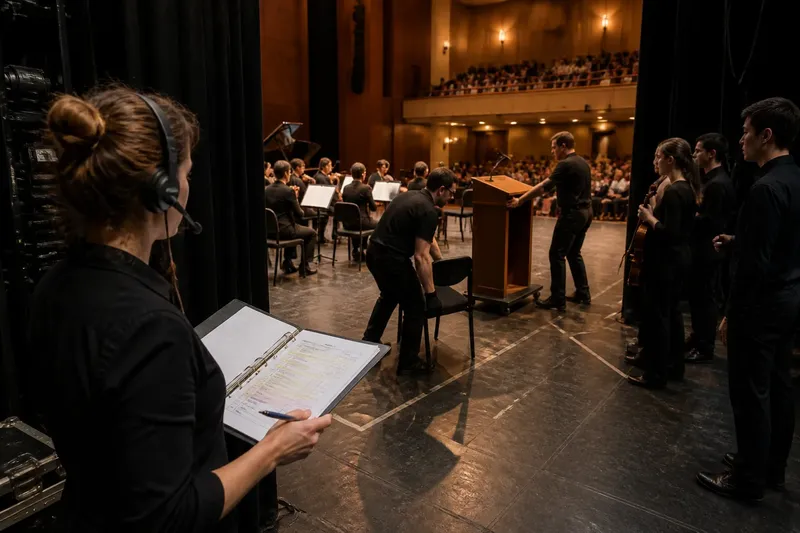
Say you have an invented concert with a short spoken introduction between two ensembles. The starting point is a lectern and two chairs onstage, with the next group waiting in the wing. The running order could assign the stage manager to call the transition, a crew member to remove the lectern, and the assistant to confirm the ensemble is in position; the observable result is a clear stage and a readiness report before the next entrance.
What is not worth the effort is recording every ordinary movement, such as each person crossing a familiar backstage corridor. Include a detail when it changes timing, access, safety, equipment, or another person’s next action. For work involving equipment or venue procedures, follow the relevant instructions and local requirements.
How should changes be passed along?
Choose one agreed route for announcing a change and one place where the current version can be checked. The point is not to create another document; it is to prevent one person from acting on a revision that has not reached the people affected by it.
When a change arrives, identify what moved, who now needs to know, and whether the hand-off owner has acknowledged it. If a spoken cue changes, for example, the stage manager and the person preparing the next entrance may both need the update. A note that appears only in one person’s copy does not complete the hand-off.
For a significant change, the owner can repeat the new instruction back in plain language. That small confirmation gives the person making the change a chance to correct a misunderstanding before it reaches the stage.
Where do hand-offs usually break?
They tend to break at boundaries: between departments, between an instruction and its confirmation, or between the planned order and a late change. A transition may look simple on paper because each person sees only their own task.
Read the order from one role’s point of view, then another’s. Ask whether the person taking over knows what has been completed, what remains, and whom to contact if the expected cue does not arrive. If the answer is missing, add a brief confirmation or escalation route rather than another paragraph of general notes.
What should a hand-off entry answer?
Who gives the next cue?
Name the role that calls or authorizes the next action, and distinguish that role from the person doing the physical task. This helps the team know where a readiness update should go.
What counts as ready?
Describe the observable condition that permits the transition, such as the lectern being clear or the next players being in position. Avoid vague terms like “all set” when the crew could interpret them differently.
What if someone is delayed?
Name the person who should be told and the decision that person can make, such as holding the next cue or adjusting the sequence. Keep the instruction within the authority and procedures established for the venue and production.
How can the order stay readable?
Keep each transition entry brief and use the same labels for roles and readiness signals throughout. Put extended technical detail in the appropriate supporting document and make its location clear.
How can the map be maintained?
Review the hand-offs with the people who will carry them out, especially where one role depends on another’s confirmation. They can spot missing ownership, ambiguous terms, and information that arrives too late to be useful.
After a revision, check the neighboring entries as well as the changed line. Moving an item can alter who is onstage, what equipment must be ready, or which cue follows; a hand-off map is only useful when those connections still match the live order.
Use “running order for concert hand-offs” as a practical editing test: can each person see what they receive, what they pass on, and who owns the moment in between? When the answer is plain on the page, the running order does more than list events—it gives the backstage team a shared point of coordination.