The Ten-Minute Post-Show Review
A ten-minute post-show review helps a concert team preserve one useful routine, clarify one snag, and assign one question before details fade.
A ten-minute post-show review gives a concert team a small, useful record while the last cues are still fresh. For a ten-minute post-show review to work, it should capture one thing to repeat, one snag to clarify, and one question to resolve before the next concert—not become a second production meeting.
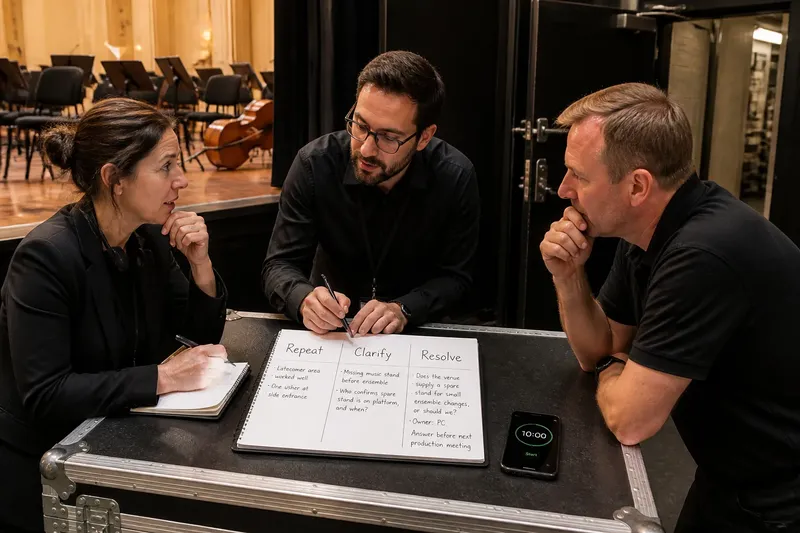
Imagine a hypothetical community orchestra has just finished a Sunday concert. The stage manager, front-of-house lead, and production coordinator are still in the hall, while musicians are packing cases and the audience has left. They agree to meet near the stage door for ten minutes, with a phone timer and a shared notes document. Their aim is not to judge the performance; it is to preserve practical learning about how the event ran.
Start with a narrow frame
The coordinator opens a blank note with three headings: “Repeat,” “Clarify,” and “Resolve.” Each person gets a short turn under each heading, but the group keeps only one item in each category. That limit forces a choice: a useful observation must be specific enough to help the next crew act.
They begin with the repeat item. The front-of-house lead says the latecomer holding area worked well because an usher stayed beside the side entrance and could direct people without interrupting the music. The team records the routine, not a vague verdict: “Repeat: assign one usher to the side entrance during the opening work; keep the latecomer area outside the hall.”
That wording matters. “Everything went smoothly” cannot guide a future decision. A named role, place, and moment can be checked against the next concert’s conditions and adjusted if needed.
Describe the snag plainly
Next, the stage manager raises a snag: a music stand was missing from the small ensemble setup, and a player borrowed one from a neighboring section shortly before the musicians entered. Nobody assigns blame. They record what was visible and what information is still absent: “Clarify: who confirms the spare stand is on the platform, and at what point?”
The distinction between a snag and its explanation is useful. The team knows a stand was unavailable at the point it was needed, but does not yet know whether the issue began with the room setup, a late change, or an unclear handoff. Guessing would turn a review note into an accusation or a false account.
So they avoid writing, “The setup crew forgot the stand.” They also avoid an empty label such as “communication problem.” The first claims a cause they have not established; the second gives nobody a concrete detail to examine.
Keep one question open
The final category is for a question that requires an answer before the next concert. The production coordinator writes: “Resolve: does the venue’s platform plan include a spare stand for small-ensemble changes, or should the orchestra supply one?” The question points toward a decision and gives someone a clear follow-up.
They assign the coordinator to ask the venue contact, with the answer due before the next production meeting. The note does not prescribe a solution in advance. If the venue has a suitable spare, the team can confirm where it is kept; if not, they can decide who brings one. The review records the unresolved choice rather than pretending it has already been settled.
Use the remaining minutes
With the three notes drafted, the group checks that each is short, distinct, and useful. The repeat item describes a routine to retain. The snag names a moment that needs clarification. The open question has an owner and a point at which the answer will matter.
They also check whether the notes contain sensitive personal details. A public or widely shared production record should focus on roles and processes, not speculate about an individual’s motives or performance. If a concern requires a private conversation, it belongs in an appropriate separate channel rather than in the brief group review.
For this invented situation, the timer has a practical purpose: it helps the team stop once the three items are clear. If a new issue needs a longer discussion, they add it to a follow-up list with an owner instead of letting one person’s concern consume the whole review. That keeps the short meeting useful without implying that every problem can be settled in a few minutes.
What should the note capture?
Who should attend?
Invite the people who can speak to the event’s practical handoffs and make or route follow-up decisions. A small group is easier to keep focused; others can send a brief observation to the coordinator beforehand.
What if nobody agrees?
Record the concrete observation and mark the cause as unresolved rather than forcing a shared explanation. The person responsible for follow-up can gather the missing information before the next planning conversation.
Should the team review the performance?
This format is for production learning, not artistic critique. Musical interpretation, programming choices, or performer feedback may need a different conversation with the right people and enough time.
What if an issue needs more time?
Write a concise follow-up question, name an owner, and set a point for checking the answer. Do not stretch the review into an improvised troubleshooting session when the group lacks the information or people needed to resolve it.
Turn notes into a habit
After the meeting, the coordinator saves the note where the production team will actually consult it before the next concert. The title includes the concert name and date, while the body keeps the three items together. There is no need for a polished report, elaborate scoring system, or long account of every moment; those additions are not worth the effort unless the team has a specific reason to maintain them.
Before the next event, the coordinator revisits the open question and updates its status: answered, still pending, or no longer relevant. The repeat item becomes a prompt to consider during planning, not a rule that must be copied regardless of venue or program. The snag’s clarification can then inform a role assignment or a check, once the team knows what actually caused the gap.
The lesson from the hypothetical orchestra is that a brief review can preserve a useful routine and expose a decision that otherwise might drift. Its value comes from disciplined wording: say what happened, separate observation from explanation, and leave the room with one answer someone is responsible for finding. That is enough to make the next concert’s preparation more informed without turning a closing conversation into another production burden.
Keep the ten-minute post-show review easy to retrieve and easy to repeat. A clear note from the stage door can be more useful than a longer document nobody opens when the next crew needs a decision.